Category

Financial Planning

HSA vs. FSA 2026: Key Differences, Contribution Limits, and How to Choose

By Financial Planning, Investments, Retirement Planning

HSA vs FSA 2026: Contribution Limits & How to Choose

Authored by Kenji Noguchi

If you have access to a Health Savings Account (HSA) or a Flexible Spending Account (FSA) through your health benefits, you’re sitting on a real opportunity to reduce your tax bill and build a stronger financial plan. Both accounts let you set aside money for qualified medical expenses on a pre-tax basis, which means every dollar you contribute goes further than it would otherwise. 

Understanding how they each work can help you get even more out of your accounts in 2026.

If you want a side-by-side breakdown of how these accounts work and how to use them more strategically, download our HSA vs. FSA guide at the end of this article.

What Is an HSA?

A Health Savings Account is a tax-advantaged account available to individuals enrolled in a High-Deductible Health Plan (HDHP). To be eligible to contribute, your health insurance plan must meet IRS criteria for an HDHP.

For 2026, an HSA-qualifying HDHP must have:

  • A minimum annual deductible of $1,700 for individual coverage or $3,400 for family coverage
  • Out-of-pocket maximums no higher than $8,500 (individual) or $17,000 (family)

(Source: IRS Rev. Proc. 2025-19)

One of the most valuable things about an HSA is its triple tax advantage:

  1. Contributions are tax-deductible (or pre-tax if made through payroll)
  2. Earnings grow tax-free
  3. Withdrawals are tax-free when used for qualified medical expenses

Few financial tools offer that level of tax efficiency.

Unlike most employer benefits, HSA funds roll over each year with no deadline to use them. The account belongs to you, and many providers allow you to invest the balance once a minimum threshold is met, creating an opportunity to treat the HSA as a long-term healthcare reserve.

After age 65, funds can be used for any purpose without penalty. Non-medical withdrawals are taxed as ordinary income, similar to a traditional retirement account.

What Is an FSA?

A Flexible Spending Account is an employer-sponsored benefit that lets you contribute pre-tax dollars toward qualified medical expenses. 

Unlike an HSA, eligibility is not tied to a high-deductible plan, which makes FSAs more broadly accessible.

FSA funds can be used for a wide range of qualified expenses, including co-pays, prescriptions, dental and vision care, and many over-the-counter items.

One structural advantage stands out: your full annual election is available at the start of the plan year, regardless of how much you have contributed through payroll. This can be meaningful if expenses arise early in the year.

The tradeoff is flexibility. FSAs are generally subject to a use-it-or-lose-it rule. Depending on your employer’s plan, you may be able to carry over up to $680, or you may be offered a limited grace period.

For 2026, you can contribute up to $3,400 to a health FSA.

(Source: IRS Rev. Proc. 2025-32)

2026 HSA vs. FSA Contribution Limits

HSA vs FSA 2026 contribution limits table

HSA (Individual): $4,400

HSA (Family): $8,750

HSA Catch-Up (55+): +$1,000

Health FSA: $3,400

FSA Carryover (if offered): $680

(Sources: IRS Rev. Proc. 2025-19; IRS Rev. Proc. 2025-32)

A Few Key Differences

Eligibility: An HSA requires enrollment in an HSA-qualified HDHP. An FSA is generally available through any employer-sponsored health plan.

Rollover: HSA balances roll over every year with no limit. FSA funds are subject to use-it-or-lose-it rules, with limited carryover options depending on your plan.

Portability: Your HSA belongs to you. If you change jobs or health plans, the account goes with you. An FSA is tied to your employer.

Investment opportunity: HSA funds can often be invested for long-term growth. FSA funds are not invested. 

Contribution source: Both you and your employer can contribute to an HSA. FSA contributions typically come through your payroll elections, and some employers contribute as well.

Funds availability: With an FSA, your full annual election is available on day one of your plan year. HSA funds are available as you contribute to them.

When an HSA May Make Sense

An HSA tends to be a strong fit if:

  • You are enrolled in, or open to, a high-deductible health plan
  • You want to build long-term savings specifically for healthcare
  • You have the ability to cover current medical expenses out of pocket
  • You are looking for additional tax-advantaged ways to complement retirement savings

Used intentionally, an HSA can function as both a spending account and a long-term asset.

When an FSA May Make Sense

An FSA can be a great fit if:

  • You are not enrolled in an HDHP
  • You have predictable, recurring medical expenses each year, such as prescriptions, contacts or glasses, or regular dental work
  • You want a simple, straightforward way to reduce your taxable income for known healthcare costs

The ability to access your full election early in the year can also make planning easier when expenses are known in advance.

Can You Have Both?

Possibly. You generally cannot contribute to both a standard health FSA and an HSA in the same year. However, a Limited Purpose FSA, which covers only dental and vision expenses, can be paired with an HSA. This combination lets you cover routine dental and vision costs through the FSA while preserving your HSA balance for other medical needs or long-term growth.

If both you and your spouse have access to FSAs through your respective employers, each of you can contribute up to the individual FSA limit.

Making the Most of Your HSA vs. FSA in 2026

Both HSAs and FSAs can play a meaningful role in a broader financial plan. The right choice depends on your health plan, your expected expenses, and how you want to approach tax efficiency over time.

For those with access to an HSA, the combination of tax treatment, rollover flexibility, and investment potential makes it one of the more powerful tools available for managing future healthcare costs.

If you’re also weighing retirement account options, see our guide to 401(k) vs. IRA or Pretax vs. Roth.

Download our in-depth HSA vs. FSA guide to better understand how to use these accounts more strategically, Enter your info below to get started.

This information does not constitute legal advice. Prime Capital Financial and its associates do not provide legal advice. Individuals should consult with an attorney regarding the applicability of this information for their situations.

Advisory products and services offered by Investment Adviser Representatives through Prime Capital Investment Advisors, LLC (“PCIA”), a federally registered investment adviser. Tax planning and preparation services are offered through Prime Capital Tax Advisory. PCIA: 6201 College Blvd., Suite 150, Overland Park, KS 66211. PCIA doing business as Prime Capital Financial | Wealth | Retirement | Wellness | Family Office | Tax Advisory.

Spousal Lifetime Access Trusts (SLATs): Giving Wealth Away Without Losing Control

By Financial Planning

Authored by Matt Waters


Wealth transfer planning often comes with a trade-off: give assets to the next generation and lose access, or retain access and risk estate taxes. Enter the Spousal Lifetime Access Trust (SLAT), a sophisticated planning tool that allows couples to transfer wealth efficiently while maintaining indirect access to funds.

SLATs could be particularly effective for today’s high-net-worth investor, when estate tax exemptions are high but future changes remain uncertain. They combine tax efficiency, asset protection, and flexibility in a way few other strategies can.

What Is a SLAT?

A SLAT is an irrevocable trust created by one spouse (the grantor) for the benefit of the other spouse, with the ultimate goal of benefiting children or other heirs.

  • The grantor transfers assets into the trust.
  • The beneficiary spouse can receive distributions from the trust for their lifetime.
  • Any appreciation inside the trust grows outside of the estate.
  • At the beneficiary spouse’s death, remaining assets pass to children or other beneficiaries tax-free.

In essence, a SLAT lets you “give away” assets for estate tax purposes while still maintaining indirect access through your spouse.

How a SLAT Works
  1. Husband creates a SLAT for Wife (or vice versa).
  2. Assets are contributed to the trust (e.g., appreciated stock, real estate, or business interests).
  3. Wife has discretionary access to income and principal from the trust.
  4. Over time, growth occurs outside of either spouse’s estate.
  5. Ultimately, assets pass to children or future beneficiaries with minimal estate tax.
Illustrative Example

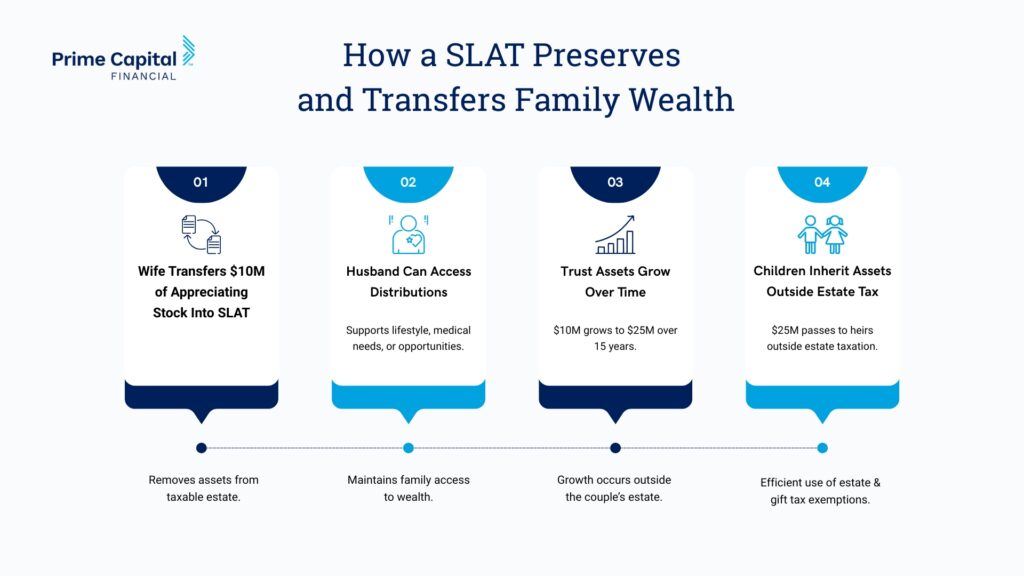
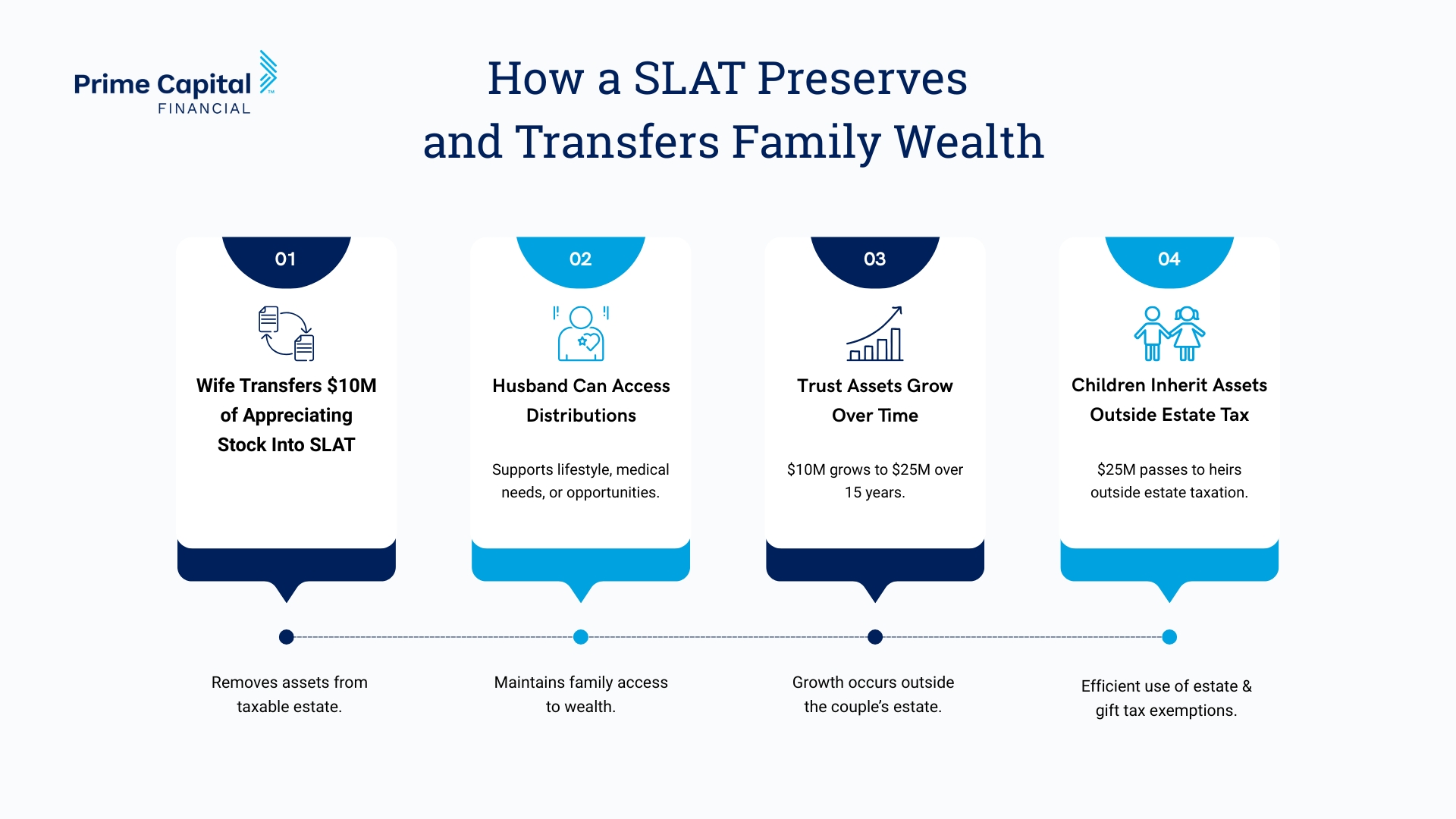
Imagine a wife transfers $10 million of appreciating stock to a SLAT for her husband:

  • Husband can receive income or distributions as needed for lifestyle, medical needs, or investment opportunities.
  • Stock appreciates over 15 years, growing to $25 million.
  • At the end, children inherit the trust assets outside of estate taxation.

This strategy keeps wealth in the family while leveraging estate and gift tax exemptions efficiently.

This illustration is hypothetical and does not represent any client or client experience. This was developed to illustrate a potential strategy, not to guarantee a specific outcome. Your experience with our firm can and will most likely differ from what is illustrated in this strategy.

Benefits
  • Indirect Access – You don’t technically own the assets, but your spouse does, giving you access through them.
  • Estate Tax Efficiency – Appreciation inside the trust avoids estate taxation.
  • Asset Protection – Trust shields assets from creditors and divorce settlements.
  • Flexibility – Can be paired with Grantor Retained Annuity Trusts (GRATs) or dynasty trusts for multi-generational planning.
Risks and Considerations
  • Reciprocal Trust Doctrine – IRS may scrutinize the move if both spouses create identical SLATs.
  • Irrevocable – Once assets are in, you can’t take them back.
  • Trustee Selection – Requires a strong, independent trustee to maintain credibility with the IRS.
  • Income Tax – Grantor may pay taxes on trust income if trust is a grantor trust.
SLATs Work Best for:
  • Married couples with large estates looking to leverage lifetime exemptions.
  • Families with appreciating assets poised for long-term growth.

Couples comfortable with irrevocable trust planning and multi-year strategies.

Final Thoughts

SLATs are a masterstroke in estate planning: giving assets away without truly losing control, maintaining flexibility, and help to provide growth benefits to the next generation efficiently.

For wealthy families, SLATs can provide a balance between control, protection, and tax efficiency — a rare combination that makes them an essential tool in the modern estate planner’s toolkit.

If you’re curious whether a SLAT is appropriate for your financial situation, we should talk.


This information does not constitute legal advice. Prime Capital Financial and its associates do not provide legal advice. Individuals should consult with an attorney regarding the applicability of this information for their situations.

Advisory products and services offered by Investment Adviser Representatives through Prime Capital Investment Advisors, LLC (“PCIA”), a federally registered investment adviser. Tax planning and preparation services are offered through Prime Capital Tax Advisory. PCIA: 6201 College Blvd., Suite 150, Overland Park, KS 66211. PCIA doing business as Prime Capital Financial | Wealth | Retirement | Wellness | Family Office | Tax Advisory.

It’s Financial Literacy Month. How Much Do You Know About Retirement Accounts?

By Financial Planning

April is often known for spring cleaning, Easter, and Passover, but it’s also Financial Literacy Month. At its core, financial literacy refers to understanding and effectively being able to use various financial tools and strategies. So, in honor of the month, we’re offering a basic financial primer, with some quick definitions and simple breakdowns of common retirement accounts.

Background: The Decline of Pensions

During the rise of the industrial age, as workers migrated and began working for factories and other enterprises, they shifted away from farming and self-sufficiency and began relying on pensions to fund their retirement. Because these pension plans were managed by their employers who tended to take care of and provide for their loyal employees, workers were little involved in strategies or decision-making when it came to planning for their own retirements.

But times have changed. The first implementation of the 401(k) plan was in 1978, and since then, has gradually supplanted the pension for most American workers. According to a congressional report, between 1975 and 2019, the number of people actively participating in private-sector pension plans dwindled from 27 million to fewer than 13 million, although public employees sometimes still have them.

Today, most workers are responsible for funding their own retirement, which makes understanding and participating in retirement accounts vital.

401(k) Plans

A 401(k) is an employer-sponsored retirement savings plan. With the traditional 401(k), employees can contribute pre-tax income into their own account, selecting among the plan’s list of options which funds they want their money invested in. Many employers will even match employee contributions up to a certain percentage.

(NOTE: In the public sector, there are 403(b)s, 457s, the TSPs (Thrift Savings Plan), and many other retirement plans which work similarly to the 401(k), but may have slightly different rules.)

With a traditional pre-tax 401(k), the employee’s contributions can reduce their taxable income for the year, since the money is deducted from their paycheck. Once an employee reaches age 59-1/2, per the IRS they can start taking withdrawals without incurring penalties, depending on their employer’s 401(k) plan rules. In retirement, they must begin taking withdrawals every year beginning at age 73, and pay taxes on the money withdrawn. (These are called required minimum distributions, or RMDs.)

Some employers also offer a Roth 401(k) option, which uses after-tax dollars. Although you must pay income taxes on the money you put into a Roth 401(k), including any employer Roth account matching amounts, a Roth option offers tax-free withdrawals in retirement as long as the account has been in place for five years or longer, no RMDs, and no taxes to your beneficiaries or heirs.

While the 401(k) can be a great way to save, it’s important to be mindful of how much you’re contributing, how your funds are invested, and what the tax ramifications of your decisions are.

Social Security

Social Security is a part of many Americans’ retirement planning. It was created as a national old-age pension system funded by employer and employee contributions, although later it was expanded to cover minor children, widows, and people with disabilities.

Established in 1935, Social Security payments started for workers when they reached age 65—but keep in mind at that time, the average longevity for Americans was age 60 for men and age 64 for women. With people living much longer, sometimes spending as long as 20 or 30 years in retirement, today Social Security must be supplemented with your own personal savings and other retirement accounts.

IRAs

Individual Retirement Accounts (IRAs) were created in the 1980s as a way for those without pensions or workplace retirement plans to save money for themselves for retirement in a tax-advantaged manner. While the tax treatment and contribution limits vary, the goal is to provide you with the means to build a retirement nest egg that can grow over time.

Types of IRAs:

  • Traditional IRA: Allows for tax deductible contributions for some people, depending on their income level and whether they have a plan through their workplace. Any growth in a traditional IRA is tax-deferred, and you’ll pay taxes when you withdraw the money in retirement. Contributions are subject to annual limits, and penalties apply if funds are withdrawn before age 59 ½, with some exceptions. RMDs must be taken annually beginning at age 73 and ordinary income taxes are due on withdrawals.
  • Roth IRA: Contributions to a Roth IRA are made with after tax income, meaning you don’t receive a tax deduction when you contribute. However, withdrawals in retirement are tax free if certain conditions are met. This account may be ideal for individuals who expect to be in a higher tax bracket in retirement. Roth IRAs are also tax free to those who inherit them if all IRS rules are followed.
  • SEP IRA (Simplified Employee Pension) and SIMPLE IRA (Savings Incentive Match PLan for Employees): For self-employed individuals and small business owners, a SEP IRA or SIMPLE IRA plan can allow for higher contribution limits for both themselves and/or their employees. And since the SECURE 2.0 Act, they can be set up as either traditional or Roth IRAs.

Annuities

Annuities are financial products designed to convert your savings into a monthly income stream, particularly during retirement. When you purchase an annuity, you exchange a sum of money for guaranteed monthly payments over a set period, or for the rest of your life, much like a pension. (Guarantees are provided by the financial strength of the insurance company providing your annuity contract.)

Annuities can be purchased using pre-tax or after-tax dollars, and they can be purchased with deferred payments over time, or with a lump sum—for example, many people roll over funds from a 401(k) into an annuity. While annuities can provide retirement income, they are not suitable for everyone.

Types of Annuities:

  • Fixed Annuity: A contract offering a fixed interest rate for a set period of time.
  • Fixed Indexed Annuity (FIA): A contract offering guarantees and policy crediting benchmarked to a stock market index, providing potential for growth along with the protection of principal from market downturns. Not actual market investments, instead, with FIAs there is the chance for crediting based on contract terms and index performance. (Guarantees are provided by the financial strength of the insurance company providing your annuity contract.)
  • Variable Annuity: A contract where the value and income payments fluctuate based on the performance of investments chosen within the annuity. The choice of investment subaccounts, like mutual funds, can increase or lose value based on market performance.
  • Registered Index-Linked Annuity (RILA): Like a variable annuity, except there is often a certain level of contractual protection from market downturns.

Life Insurance

Life insurance can provide financial protection for your loved ones by offering a death benefit paid to a beneficiary upon your passing. Policies vary widely, but they generally aim to replace lost income, cover debts, or fund future expenses. Some policies, like permanent life insurance, can also build cash value over time, which can be borrowed for various needs, including retirement income.

It’s important to work with your financial advisor to find the right policy for your needs, and remember, medical underwriting may be required.

Types of Life Insurance

  • Term Insurance: Provides a death benefit if the insured passes away within a specified term (e.g., 1, 2, 10, 15, or 30 years). Premiums are typically level for a certain period but may increase with age. Once the term expires, the policy ends.
  • Whole Life: A permanent policy with fixed premiums and guaranteed cash value accumulation.
  • Universal Life: Offers flexibility in premium payments, death benefit amounts, and the policy’s cash value. It allows policyholders to adjust the death benefit and premiums based on changing needs, and in some cases, premiums can be paid using the cash value. Indexed Universal Life (IUL) policies are benchmarked to a market index like the S&P 500 (but not actually invested in the market) and policies may be credited based on performance, while offering protection from market downturns.
  • Variable Life: Comes in two forms—variable and variable universal life. Both variable life insurance (VL) and variable universal life (VUL) insurance are permanent coverage that allocate cash value to market investment subaccounts which can lose value, but with variable life, there is a fixed death benefit, while with VUL, there is a flexible death benefit and adjustable premium payment amounts.

Whether you’re just starting to think about retirement or are near retirement age, it’s never too late to learn more, or take action to create your own personal retirement plan. If you’re unsure about your retirement options or would like assistance planning for your financial future, please reach out to us!

Guide to Advanced Retirement & Estate Planning for Affluent Families

Guide to Advanced Retirement & Estate Planning for Affluent Families

By Estate Planning, Financial Planning

Authored by Matt Waters

Imagine entering retirement not with concern, but with confidence—knowing that your wealth is working as hard for future generations as it did for you. For high net worth families, retirement planning is far more than replacing income; it’s about preserving a legacy. Strategic retirement and estate planning requires advanced tax mitigation, sophisticated asset protection, and thoughtful generational wealth transfer.

As affluent individuals near retirement, they face complex challenges such as managing Required Minimum Distributions (RMDs), minimizing estate tax exposure, and ensuring the seamless transition of wealth. With shifting tax laws, market volatility, and evolving family dynamics, high-net-worth retirement planning demands a proactive, comprehensive approach to secure long-term financial stability and legacy preservation.

Strategic Approaches:

  • Tax-Optimized Withdrawal Sequencing: A carefully orchestrated approach to drawing from tax-deferred, tax-exempt, and taxable accounts mitigates unnecessary taxation while extending portfolio longevity. This entails tactical Roth conversions, strategic liquidation of high-basis assets, and optimizing Social Security deferral benefits.
  • RMD Precision Planning: Neglecting RMD requirements can result in punitive tax consequences. Strategic foresight can provide adherence to regulatory mandates while integrating tax-efficient withdrawal methodologies. Cutting-edge financial planning models track and forecast future RMD obligations, empowering families to align distributions with their broader wealth preservation strategy.
  • Sophisticated Estate Structuring: High-net-worth families leverage irrevocable trusts, philanthropic giving frameworks, and dynasty trust vehicles to help shield assets from excessive taxation while maintaining governance over generational wealth succession. Thoughtful estate planning mitigates probate inefficiencies and potential intra-family conflicts.
  • Advanced Scenario Simulations: By modeling diverse economic landscapes—including tax law amendments, inflationary pressures, and portfolio volatility—families can evaluate the resilience of their wealth strategy. Rigorous stress testing can provide robust preparedness for dynamic financial environments.

Show me how advanced estate planning works:

John and Susan, a couple nearing retirement, hold a $15 million portfolio with significant assets in tax-deferred accounts. With the help of their financial advisor, they develop a tax-optimized withdrawal strategy that includes Roth conversions and targeted RMD distributions to minimize their taxable income. By leveraging charitable giving strategies, they also reduce estate taxes, which can provide their children inherit a more substantial legacy. Specifically, they:

  • Convert annually from their traditional IRA to a Roth IRA, staying within an optimal tax bracket, saving future tax liabilities over ten years.
  • Use Qualified Charitable Distributions (QCDs) to donate directly from their IRA, reducing their taxable RMDs, effectively lowering their annual tax bill.
  • Establish a Charitable Remainder Trust (CRT) to defer capital gains tax while generating retirement income, securing additional tax-free income over their lifetime.
  • Implement an irrevocable life insurance trust (ILIT) to provide tax-free wealth transfer, mitigating estate tax liabilities.

If you need help or want to chat with a financial advisor in our Denver office, we would love to talk to you about your specific situation.

Wealth and Financial Planning Denver Colorado

Mastering Wealth with Financial Planning

By Financial Planning

Authored by Matt Waters

As you approach retirement, managing wealth effectively becomes more complex. From tax-efficient income strategies to estate preservation, financial planning is the cornerstone solution for any high-net-worth individuals nearing retirement. Whether you’re structuring generational wealth transfers, maximizing returns, or preparing for healthcare expenses, financial planning offers the tools needed to help you with your financial future.

With evolving market conditions, tax regulations, and increasing longevity, having a robust financial plan is more essential than ever. Financial planning helps pre-retirees and retirees navigate these complexities while mitigating those market-induced roller coaster stomach drops.

Why Financial Planning?

At the Prime Capital Financial Denver office, we use an integrated platform for financial planning called eMoney. If you’re not familiar, eMoney consolidates all aspects of an investor’s financial situation into one intelligent dashboard. It enables real-time financial tracking, predictive modeling, and secure document storage, making it easier to manage assets, reduce tax liabilities, and plan for the future with confidence. By offering a holistic view of your financial health, eMoney helps users visualize long-term projections, stress-test various scenarios, and create data-driven strategies that align with their retirement and estate goals.

Unlike traditional financial tools that only offer basic budgeting and investment tracking, eMoney provides sophisticated, high-level insights into your wealth, giving you better insights for your financial planning. The ability to integrate multiple accounts, analyze tax-efficient withdrawal strategies, and monitor market shifts helps you remain proactive rather than reactive in your financial decisions.

Key Features of eMoney

📈 Denver Retirement & Estate Planning

  • Model tax-efficient withdrawals, Required Minimum Distributions (RMDs), and long-term income strategies to create a sustainable lifestyle while preserving wealth for heirs.
  • Generate and compare multiple retirement scenarios to assess the impact of different investment strategies, Social Security timing, and pension options.
  • Adjust and test estate planning structures, helping heirs receive the maximum benefit while minimizing estate taxes.

💰 Wealth Aggregation

  • Consolidate investment portfolios, trusts, real estate, business assets, and alternative investments into one secure, easily accessible dashboard.
  • Track performance across multiple asset classes and keep your portfolio balanced according to your risk tolerance.
  • Integrate with third-party financial institutions to keep all your data updated in real-time.

🏦 Tax & Cash Flow Optimization

  • Utilize real-time tax modeling to maximize after-tax returns and strategically plan distributions to minimize liabilities.
  • Forecast the tax impact of Roth conversions, charitable donations, and capital gains strategies.
  • Identify efficient ways to withdraw from tax-deferred, tax-free, and taxable accounts to reduce overall tax burdens.

🔒 Secure Digital Vault

  • Store and organize wills, trusts, power of attorney documents, insurance policies, and financial statements in a secure, encrypted environment for seamless estate execution.
  • Give your beneficiaries and trustees access to critical documents when needed.
  • Keep digital copies of important legal agreements, tax returns, and insurance policies in a centralized location.

🤝 Advisor Collaboration

  • Enable seamless communication with our team financial advisors in Denver, estate planners in Denver, and tax professionals in Denver to optimize and execute your wealth strategy efficiently.
  • Share reports and projections securely with trusted professionals to keep everyone aligned with your financial objectives.
  • Receive professional guidance on investment strategies, tax laws, and changing estate regulations in real-time.

📊 Scenario Planning & Risk Assessment

  • Run what-if analyses to assess the impact of market downturns, healthcare costs, and inflation, helping your portfolio remain resilient in any economic climate.
  • Stress-test your retirement plan against unexpected medical expenses, economic downturns, and longevity risks.
  • Evaluate how various market conditions and interest rate changes will affect your portfolio over time.

Who Benefits from a Tool Like eMoney?

👨‍👩‍👧‍👦 Affluent Individuals & Families in Denver

  • Gain clarity and control over generational wealth transfer and inheritance tax planning.
  • Help your heirs prepare with structured inheritance plans and clear distribution strategies.
  • Protect family wealth through multi-generational estate planning techniques.

👔 Denver Executives & Business Owners

  • Integrate business and personal finances, strategize liquidity events, and help maximize tax efficiency.
  • Plan for business succession, mergers, or liquidation strategies with a tax-efficient approach.
  • Optimize retirement plans including 401(k), SEP IRA, and non-qualified deferred compensation plans.

🏖️ Pre-Retirees & Retirees

  • Optimize retirement income distribution strategies, manage healthcare costs, and encourage financial independence.
  • Determine the best time to claim Social Security benefits to help maximize lifetime payouts.
  • Forecast long-term healthcare expenses, including Medicare and long-term care insurance needs.

Final Thoughts

For high-net-worth individuals near or in Denver nearing retirement, eMoney is a powerful financial planning tool that is integral to planning for your long-term financial goals. Whether facilitating a tax-efficient wealth transfer, optimizing investment performance, or preparing for unforeseen expenses, financial planning provides the clarity and confidence needed for a more stable financial future.

While we can’t ever make any guarantees, one thing is for certain – the markets will go up and they will go down. The key to creating more stability is proactive planning. By working with a Prime Capital Financial advisor located in our Denver office to leverage eMoney’s advanced tools, you can make informed, data-driven decisions that help protect and grow your wealth. Whether you’re planning for retirement, managing a complex investment portfolio, or securing your legacy, financial planning empowers you to take full control of your financial future.

Prepare for a legacy that lasts. Chat with a local Denver advisor today.

Do You Know the Connection Between Income and Medicare Costs?

By Financial Planning

As you near retirement you’re probably focused on making sure you have enough income to enjoy the years ahead. While enjoying what you’ve worked hard to build should be a priority, you should also keep in mind that withdrawing the money you’ve saved in traditional 401(k)s and IRAs can impact your Medicare costs throughout your retirement. Read on to see what having a high income could cost you in Medicare premiums and what strategies could potentially help you keep more money in your pocket and less going to Medicare premiums which are deducted from your Social Security check.

Understanding Medicare

First make sure you understand Medicare, how it’s broken up, and what plan you will likely choose. Medicare is sectioned into different parts, each serving a unique role in delivering health care coverage. These parts include Part A, Part B, Part D, and additional coverage options like Medicare Advantage (Part C) and Medigap.

  • Part A (Hospital Insurance): Covers inpatient hospital stays, skilled nursing facility care, hospice care, and limited home health care. This is normally free for most people who have qualified for Medicare coverage.
  • Part B (Medical Insurance): Covers doctor visits, outpatient care, home health care, and preventive services like screenings and wellness visits, along with durable medical equipment (e.g., wheelchairs). Part B coverage is the premium that will be deducted from your Social Security check if you don’t choose Medigap or Part C.
  • Part D (Prescription Drug Coverage): Helps cover the cost of prescription medications, including certain vaccines. You can get Part D as a standalone plan along with Part B or as part of a Medicare Advantage Plan.
  • Medicare Supplemental Insurance (Medigap): Extra coverage from private insurers to help pay for out-of-pocket costs in Original Medicare, such as copayments and coinsurance. Plans are standardized by letter (e.g., Plan G, Plan K).
  • Part C (Medicare Advantage Plans): Private, Medicare-approved plans that may bundle Part A, Part B, and often Part D (prescription drug) coverages. Usually limited to providers within the plan’s network. May have different out-of-pocket costs and additional benefits not available in Original Medicare, like vision and hearing coverage.

Comparing Your Choice of Original Medicare with Medicare Advantage

Original Medicare

  • Includes Part A and Part B.
  • Option to add Part D for prescription coverage.
  • Flexibility to see any Medicare-accepting provider in the U.S.
  • You can also add Medigap for extra coverage on costs not covered by Original Medicare.
Medicare Advantage (Part C)

  • Private, Medicare-approved plans that bundle Part A, Part B, and often Part D (prescription drug) coverages.
  • Usually limited to providers within the plan’s network.
  • May have different out-of-pocket costs and additional benefits not available in Original Medicare, like vision and hearing coverage.

Understanding Modified Adjusted Gross Income (MAGI)

There is one thing that will have a huge impact on your Medicare costs— your modified adjusted gross income (MAGI). Your MAGI is your adjusted gross income (AGI) minus allowable tax deductions and credits. Once you retire, you may be surprised to find that a combination of income from pensions, investment earnings, traditional (non-Roth) IRA withdrawals, and traditional 401(k) withdrawals may land you with a higher MAGI than you realized. While you may no longer be earning a traditional income from working a job, your MAGI will still reflect all of your taxable income.

RMD Impacts

A required minimum distribution (RMD) is the amount you are required to withdraw annually from specific retirement accounts, such as traditional (non-Roth) 401(k)s and traditional Individual Retirement Accounts (IRAs). Starting at age 73, you must take your first RMD by April 1 of the following year, and each subsequent RMD must be taken by December 31 each year after. These mandatory withdrawals are added to your taxable income, minus any allowable deductions or credits.

Higher Medicare Premiums for High Earners

How does retirement income connect to Medicare premium costs? If you have a high income, you will be subject to an income-related monthly adjustment amount (IRMAA) that must be paid in addition to Medicare Part B and Part D premiums, and it’s calculated every year. If the SSA determines you must pay an IRMAA, you’ll receive a notice with the new premium amount and the reason for it.

For 2025, the standard monthly premium is $185 per person per month. In 2025, single filers with 2023 MAGI of more than $106,000 and married couples filing jointly with 2023 MAGI of over $212,000 will pay more. (See Two-Year Lookback below for why we used 2023 MAGI.)

The Part B IRMAA surcharge amounts per person per month for 2025 range from $74.00 to $443.90, while Part D surcharges range from $13.70 to $85.50 depending on income!

Other Impacts

Other income sources can also contribute to an increased MAGI. Capital gains, home sale profits, and even Treasury bill yields contribute to a retiree’s MAGI.

Two-Year Lookback

Now that you know what contributes to your MAGI, know that when you go to enroll in Medicare, your MAGI from your tax return two years prior will determine your premiums. This “two-year lookback” rule can catch retirees off-guard if they receive large distributions or gains, increasing their premiums unexpectedly. This is why it’s a good idea to start preparing for premium costs as soon as possible, and be strategic about it. The last thing you want is to be settling into retirement and then be hit with a high premium if you can avoid it. Be aware that the two-year lookback is ongoing throughout your retirement, and your premiums may go up in any given year if your income goes up two years prior.

Potential Strategies

By now you know that your Medicare premiums are directly influenced by your modified adjusted gross income (MAGI)—the higher your MAGI, the higher your premiums may be. To help manage this, it helps to work with a retirement planner years before filing for Medicare at age 65, and years before you plan to retire so that a specific retirement income plan can be created for you.

Your advisor will work with you to map out your retirement with a strategy that includes which accounts to draw from and/or which taxable accounts you might want to convert to Roth accounts to potentially save money for the long-term. It all works together!

Planning for Medicare can seem like an overwhelming process. From knowing which retirement accounts to leverage to help keep your MAGI as low as possible, to accounting for that two-year lookback, it can be a lot. That’s why the best place to start in your plan is talking to someone knowledgeable about retirement planning.

If you need help getting started in your Medicare planning, we’re here to help!

What’s Your Relationship with Your Finances?

By Financial Planning

An often-overlooked relationship is the one we have with our finances. As we celebrate the month of love, reflect on whether the relationship you have with your finances supports your long-term goals, or if a shift in that relationship is needed.

When you think about your finances, what’s the first feeling that comes to mind? Is it confidence? Indifference? Or perhaps anxiety? Like any relationship, your relationship with money requires consistent effort and care if you want it to be a fulfilling one. It’s also a malleable relationship, meaning that even if you feel overwhelmed by financial stress or detached from your goals right now, you can always change it to one that makes you feel confident about your financial future.

First, understand your relationship with money was probably determined early on in life, maybe before you even understood the concept of money. This could be when you were a child seeing your parents or caregivers anxiously struggling to make ends meet, or seeing them spend money without considering long-term goals, etc. With that in mind, here’s how three different childhood “attachment” styles used in psychology may manifest in present-day financial behaviors:

Anxious

Anxious attachment is characterized by a fear of abandonment and rejection. These individuals probably had inconsistent caregivers who were sometimes there and sometimes not. This made it hard for them to trust when things were good that the other shoe wouldn’t soon drop. When applied to finances, this could manifest as someone feeling overwhelmed, constantly worried that anything and everything could derail the progress they’ve made. These individuals often lack confidence in their ability to achieve their financial goals, even when all evidence suggests otherwise. Consumed by worry, they may find themselves paralyzed, unable to make the decisions necessary to reach their goals.

Avoidant

An avoidant attachment style involves a fear of closeness and difficulty trusting others as trusting others involved consistent disappointment in their earlier life. If someone has an avoidant style when it comes to their relationship with money, they may detach themselves from financial planning and long-term goals. If they avoid making goals, then there’s no fear of failure, but there will also never be any progress. These individuals might procrastinate, downplay the importance of financial milestones, or dismiss the need for accountability, all as a means of maintaining control while avoiding the potential disappointment that comes with falling short of their goals.

Secure

Finally, a secure attachment style enables an individual to feel safety, stability, and trust in close relationships. These are the people who had caregivers who offered affection when needed, encouraged independence, and were consistent. In the context of finances, someone with this attachment style approaches their goals with confidence. They trust their ability to make decisions that support their goals. They’re able to be present, engaged, and adaptable as circumstances change without feeling overwhelmed. Rather than fixating on the possibility of failure, they focus on success and the steps needed to achieve it.

Cultivating a Secure Attachment Style

To cultivate a more secure attachment with your finances, think about what the behaviors of someone with a secure attachment might be. Some things you may want to consider:

  • General Financial Wellness: This includes having a monthly budget, an emergency fund, and a robust savings account. Don’t let this first part overwhelm you, break it down into smaller, manageable steps and turn each one into its own goal!
  • Maintain Financial Awareness: It’s so easy to check out financially. Push back the resistance that makes you want to check out, and keep track of bill increases, unnecessary purchases, and anything else that can burn a hole through your wallet.
  • Set Goals: Know what you want to accomplish. If you neglect to define your goals you will never achieve them.
  • Protect Yourself and Your Family: While preparing for the unexpected can be difficult, having a plan in place can help you face these challenges without feeling overwhelmed or shut down. For this, you may want to consider a life insurance policy that works for you and your family. And having a will and/or estate plan can also help give you peace of mind about your loved ones.
  • Know Your Triggers: If your attachment style leans anxious or avoidant, understand what triggers that attachment style. For example, if receiving a bill is the trigger, how can you address that? Maybe you can enroll in automatic payments, or maybe set aside time every so many days to go over your bills, or maybe something entirely different altogether.
  • Seek Help: Changing your attachment style is no small task, but you don’t have to do it alone! Partnering with an experienced financial advisor can make the process more manageable and less overwhelming. 

If you’re looking for support in navigating your financial attachment style or want guidance to help you maintain a more secure mindset, we’re here to help!

Setting Financial Goals for the New Year

By Financial Planning

It’s that time of year again—the time when many people set ambitious goals but struggle to follow through on achieving them.

As you reflect on your financial health, it’s important to remember that everyone is in a different place financially. Tailoring your resolutions to fit your unique situation can make a significant difference. Here are five steps that can help you set and achieve your financial goals, along with suggestions and strategies for short-term, mid-term, and long-term goals to help keep you on track.

Step 1: Reflect on Your Current Financial Situation

Begin with a thorough examination of your existing financial landscape. Review your income, expenses, assets, and liabilities. This analysis will provide a comprehensive understanding of your economic standing and help you craft a personalized plan for your financial future.

Step 2: Establish Clear Objectives

Articulate your financial objectives clearly. Whether your aim is to build an emergency fund, plan for a dream vacation, buy a home, or prepare for retirement, identifying your goals sets the foundation for your financial journey. Consider the time frame associated with each objective, from short-term to long-term commitments. (See below for more.)

Step 3: Make Your Goals SMART

Adhering to the SMART criteria helps to ensure your goals are clear and achievable:

  • Specific: Clearly define what you want to accomplish. For example, “Save $10,000 for a car down payment.”
  • Measurable: Set specific amounts and deadlines, like “Save $500 per month for 20 months to reach $10,000 by a specific date.”
  • Achievable: Make sure your goals are realistic within your current financial situation.
  • Relevant: Align your financial goals with your overall life objectives.
  • Time-Bound: Set a deadline for each goal to create a sense of urgency.

Step 4: Seek Professional Advice

Consider consulting a financial advisor, especially for complex goals like retirement planning or investment strategies. Advisors can provide tailored guidance and valuable insights to help you make informed decisions. Don’t hesitate to ask for help; their knowledge can greatly enhance your financial well-being.

Step 5: Stay Disciplined and Motivated

To achieve your goals, discipline is crucial. Regularly check your progress and celebrate milestones. Keep your ultimate dreams at the forefront of your mind. This personal financial journey requires consistency and enthusiasm.

Short-Term Financial Goal Ideas

  • Create and Stick to a Budget

Establishing a budget is a foundational step in financial planning. Track your income and expenses to understand your financial habits and use budgeting tools to categorize your spending. Identify areas to cut back and allocate funds toward savings or debt repayment.

  • Build an Emergency Fund

An emergency fund is important for financial stability. Start small with a goal of $500 to $1,000, and gradually expand it to cover three to six months of living expenses, or more depending on your situation. Consider automated savings transfers to this dedicated account, helping you prepare for unexpected financial shocks.

Mid-term Financial Goal Ideas

  • Save for Major Life Events

Consider significant life events like buying a home or funding a child’s education. Start by estimating the total amount needed and set a timeline for achieving it, breaking it down into monthly savings targets.

  • Pay Off Student Loans

If you have student loans, strategize to pay them off effectively. Explore refinancing options to help secure a lower interest rate while considering the potential loss of federal loan benefits.

Long-Term Financial Goal Ideas

  • Save for Retirement

Experts recommend that you work toward a comfortable retirement by saving 10-15% of your income in tax-advantaged retirement accounts, or more if possible. As you get closer to retirement, you should work with an advisor to create a customized retirement income plan based on your personal retirement lifestyle goals. Estimate your desired annual expenses to help gauge how much you will need.

  • Plan for Major Life Transitions

Consider potential long-term goals, such as caring for aging parents or planning for long-term care. Early planning and dedicated savings can help alleviate future financial pressure.

The Importance of Ongoing Financial Planning

Remember, achieving financial goals is not always a linear process. Life can throw unexpected challenges your way. It’s beneficial to remain flexible and adjust your goals as needed. Embrace the new year as an opportunity to shape your financial future, and take proactive steps toward achieving your dreams.

Call us and let’s talk about your goals for 2025!

10 Considerations for Year-End Tax Planning

By Estate Planning, Financial Planning

As we head into the holiday season, another season looms in the distance: tax season.

Don’t wait until March to see how 2024 shook out for you tax-wise. Before the year draws to a close, it’s an ideal time to evaluate financial strategies and take advantage of year-end tax planning opportunities. Now is the time to proactively review, consult with professionals, and implement strategies that can potentially benefit you now and in the years ahead.

  1. RMDs (Required Minimum Distributions) Due In Retirement

Required minimum distributions (RMDs) must be withdrawn from traditional retirement accounts like 401(k)s and IRAs by December 31 each year beginning at age 73. There is no grace period to April 15 tax day; RMDs must be taken by December 31.

  1. Calculate RMDs (Required Minimum Distributions) Before Retirement

Even if you are not 73 or older, remember, all the money you have socked away in traditional 401(k)s, IRAs, and similar qualified retirement accounts will require annual withdrawals, and ordinary income taxes will be due on the amounts withdrawn. According to the Social Security Administration, around 40% of Americans must pay federal income taxes on their Social Security benefits—up to 85%—because they have substantial income, like the income created by required minimum distributions. 

  1. Strategic Timing for Roth Conversions

Converting traditional IRAs or other tax-deferred accounts to Roth IRAs can be a strategic move, particularly if you anticipate being in a higher tax bracket in the future. Roth accounts contain already-taxed money, so they offer tax-free growth and withdrawals, meaning you can access your money in retirement without owing any federal taxes provided the account has been in place five years and all other IRS rules are followed. They are also tax-free to your heirs.

While there are no limits on the amounts you can convert, it’s essential to remember that the converted amount will be added to your gross income for the year, potentially affecting your overall tax situation. And since Roth conversions cannot be undone, it’s important to seek professional tax advice.

  1. RMDs (Required Minimum Distributions) Due On Inherited Accounts

This July, the IRS finally issued clarifications about the SECURE Act 1.0 changes on the rules for non-spousal inherited traditional accounts, stating that enforcement will begin in 2025 on accounts inherited after 2019. If you inherited a traditional IRA or 401(k) or similar account, check with your CPA or tax professional now because RMDs will be due or you may owe penalties.

  1. Maximize Retirement Account Contributions

If you are still working, contributing the maximum allowable amounts to tax-deferred retirement accounts like traditional 401(k)s and IRAs can offer a significant opportunity to grow your retirement savings while reducing your taxable income for the tax year. The contribution limit for 401(k) plans for 2024 is $23,000 for individuals under 50, with an additional catch-up contribution of $7,500 for those 50 and older, bringing the total to $30,500. For IRAs, the limit is $7,000, or $8,000 with the catch-up provision for those 50 and older.

  1. Implement Tax Loss Harvesting

If you’re seeking to reduce your taxable capital gains in 2024, tax loss harvesting may be a strategy worth considering. This involves selling underperforming investments, such as stocks and mutual funds, to help realize losses that can offset any taxable gains you may have accrued throughout the year.

  1. Charitable Contributions

A charitable donation is a gift of cash or property given to a nonprofit organization to support its mission, and the donor must receive nothing in return for it to be tax-deductible. Taxpayers can deduct charitable contributions on their tax returns if they itemize using Schedule A of Form 1040, and contributions may be deductible to up to 60% of adjustable gross income for 2024.

  1. Defer Income

Another way to help reduce your tax burden is by deferring, or shifting, income to the next year. If you’re employed, you won’t be able to defer your wages; however, you could delay a year-end bonus to the following year, so long as it’s a standard practice at your company.

  1. Be Mindful of the Alternative Minimum Tax (AMT)

The alternative minimum tax (AMT) is designed to ensure that high-income individuals pay a minimum level of tax, regardless of how many deductions or credits they claim under the regular tax rules. The AMT is calculated by adding back certain deductions, such as state and local taxes, that are allowed under the regular system but not under AMT rules. In 2024, the AMT tax exemption for individuals is $85,700, and for married couples it’s $133,300.

  1. Utilize Flexible Spending Accounts (FSAs) and Other Tax-Advantaged Accounts

For 2024, flexible spending accounts (FSAs) offered an increased contribution limit of $3,200, up from $3,050 in 2023, allowing employees to use pre-tax dollars for eligible medical expenses. Contributions to FSAs reduce taxable income, as funds are deducted before federal, Social Security, and Medicare taxes are applied. However, it’s essential to use all FSA funds before year-end to avoid forfeiture under the “use it or lose it” rule. Some employers offer a grace period, extending the deadline to use 2024 funds until March 15, 2025. Exploring other tax-advantaged accounts for 2025, such as dependent care FSAs, might further reduce future taxable income while maximizing the benefit of pre-tax dollars for qualifying expenses.

Don’t let time pass you by, start planning for this upcoming tax season today! If you’re not sure how these tips could be plugged into your overall financial plan, let’s meet together with your tax professional. We’re here to help you end the year strong financially. Give us a call today at (316) 655-9136!

This article is provided for general information only and is believed to be accurate. This article is not to be used as tax advice. In all cases, we advise that you consult with your tax professional, financial advisor and/or legal team before making any changes specific to your personal financial and tax plan.

Sources:  

  1. https://rodgers-associates.com/blog/your-2024-guide-to-year-end-tax-planning/
  2. https://turbotax.intuit.com/tax-tips/tax-planning-and-checklists/top-8-year-end-tax-tips/L5szeuFnE
  3. https://www.tiaa.org/public/invest/services/wealth-management/perspectives/5-year-end-tax-planning-strategies-to-consider-now
  4. https://smartasset.com/taxes/can-short-term-capital-losses-offset-long-term-gains
  5. https://www.investopedia.com/articles/personal-finance/041315/tips-charitable-contributions-limits-and-taxes.asp#
  6. https://www.schwabcharitable.org/giving-2024
  7. https://www.fidelitycharitable.org/guidance/philanthropy/qualified-charitable-distribution.html
  8. https://www.investopedia.com/terms/a/alternativeminimumtax.asp
  9. https://fairmark.com/general-taxation/alternative-minimum-tax/top-ten-things-cause-amt-liability/
  10. https://www.irs.gov/newsroom/irs-2024-flexible-spending-arrangement-contribution-limit-rises-by-150-dollars
  11. https://turbotax.intuit.com/tax-tips/health-care/flexible-spending-accounts-a-once-a-year-tax-break/L8hwzKu7r
  12.  https://www.schwab.com/learn/story/rmd-reference-guide
  13. https://www-origin.ssa.gov/benefits/retirement/planner/taxes.html

Estate Planning Awareness Month: Prepare for Your Family’s Future

By Estate Planning, Financial Planning

October is recognized as Estate Planning Awareness Month, a reminder to reflect on the importance of organizing your affairs for the benefit of your loved ones.

As we approach 2025, at the end of which the current estate tax exemption is set to expire to around half of what it is now, it’s important to revisit your estate plan and explore options like life insurance and trusts to safeguard your legacy.

Why Estate Planning Matters

Estate planning involves organizing your financial affairs so that your assets and responsibilities are managed according to your wishes upon your death or incapacitation. An effectively written and legally executed estate plan aims to provide peace of mind for you and your loved ones during a time of loss or medical crisis, and can pave the way for an easy, tax-advantaged transfer of assets and decision-making authority to your chosen beneficiaries.

Key Legal Documents to Consider

Effective estate planning often relies on several essential documents:

  1. Will: This legal document specifies how your assets should be distributed after your death and chosen guardians for your children. It is crucial for specifying which items go to whom, even if you also have a trust; in that case, it functions as a pour-over will. Dying intestate can complicate matters, as state laws and probate court will dictate asset distribution.
  2. Trust: There are many types of trusts, but in general, a trust can allow you to designate a trustee to manage your assets for beneficiaries. This can expedite asset distribution and potentially bypass probate court, as well as keep matters private.
  3. Power of Attorney (POA): This grants someone the authority to make financial or medical decisions on your behalf if you become incapacitated.
  4. Living Will: This document outlines your preferences for medical treatment and end-of-life care, so your wishes are honored.

The Importance of Life Insurance and Trusts

As the estate tax exemption changes, it’s wise to explore life insurance and trusts for potential tax advantages. Life insurance offers tax-free liquidity for your family to cover expenses, easing financial burdens on beneficiaries. Trusts can protect assets from estate taxes and streamline distribution, potentially avoiding costly probate.

Many types of trusts can address different situations, so it’s essential to seek legal guidance for proper setup and execution.

Revisiting Your Estate Plan: Key Considerations

The lifetime gift and estate tax exemption amount is set to drop to nearly half from its current $13.61 million per person. If the Tax Cuts and Jobs Act (TCJA) provisions expire as planned, the exemption could drop to around $7.5 million per person for the 2026 tax year, adjusted for inflation. Families facing potential estate tax liability in excess of this amount should consider consulting with their attorney and financial professional as soon as possible, implementing a plan no later than next year, in 2025.

Common Estate Planning Mistakes

The most significant mistake is not having a plan at all. Other pitfalls include failing to communicate your wishes, naming only one beneficiary, and neglecting to update your plan after major life changes like marriage, divorce, or the birth of children. Regularly reviewing your estate plan—ideally every three to five years—can help ensure your documents remain aligned with your current situation. Without a clear estate plan, your assets could end up in probate court, leading to delays and potential family disputes, distribution will be based on state laws that may not reflect your intentions.

Conclusion

Procrastination is the enemy of effective estate planning, especially as we approach significant changes in estate tax laws. Take this opportunity during Estate Planning Awareness Month to organize your affairs and make certain your wishes are honored. Remember Benjamin Franklin’s words: “By failing to prepare, you are preparing to fail.” Acting now will help protect your loved ones and facilitate efficient management of your estate.

We are available to meet with you, your estate attorney, and your tax professional to create or review your estate plan. We can also bring these disciplines to the table if you don’t have them in place. Call us!